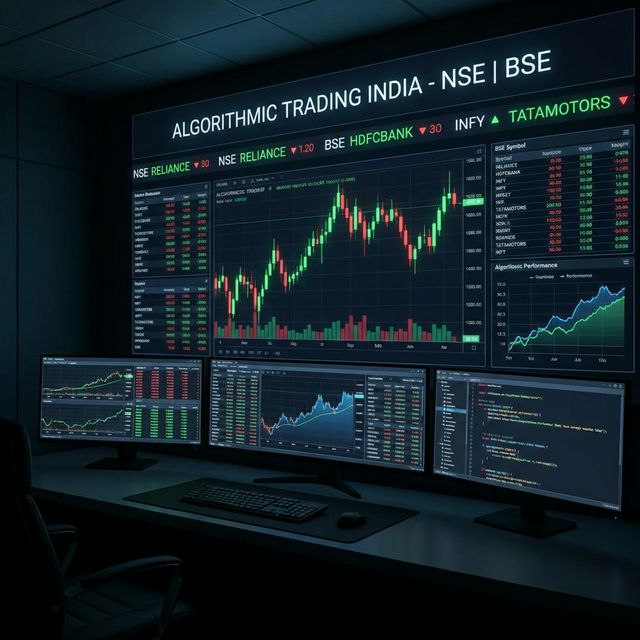
Top 5 Algorithmic Strategies for Global Forex Markets
- John Doe
- Forex Trading, Global Markets
- 12 Feb, 2026
The global forex market operates 24/5, trading over $7 trillion daily. For algorithmic traders, this presents unparalleled opportunities to automate strategies and capitalize on currency movements across EUR/USD, GBP/USD, USD/JPY, and other major pairs.
Why Automate Forex Trading?
Manual forex trading requires constant monitoring across multiple time zones. Algorithmic trading solves this by:
- 24/5 Execution: Trade around the clock without human intervention
- Emotion-Free Trading: Remove fear and greed from decision-making
- Backtesting: Validate strategies on years of historical data
- Multi-Pair Monitoring: Track dozens of currency pairs simultaneously
Top 5 Forex Algo Trading Strategies
1. Trend Following Strategy
How it works: Identify and trade in the direction of established trends using moving averages, MACD, or ADX indicators.
Best for: Trending markets (breakouts, strong directional moves)
Example:
- Buy when 50-day MA crosses above 200-day MA
- Sell when 50-day MA crosses below 200-day MA
Risk: Whipsaws in ranging markets
2. Mean Reversion Strategy
How it works: Bet on prices returning to their historical average after extreme moves. Uses Bollinger Bands or RSI to identify overbought/oversold conditions.
Best for: Range-bound, sideways markets
Example:
- Buy when price touches lower Bollinger Band
- Sell when price touches upper Bollinger Band
Risk: Trends can persist longer than expected
3. Grid Trading Strategy
How it works: Place multiple buy and sell orders at fixed intervals above and below the current price. Profit from volatility within a range.
Best for: Choppy, non-trending markets
Example:
- Set buy orders every 20 pips below current price
- Set sell orders every 20 pips above current price
Risk: Large drawdowns if market trends strongly in one direction
4. Breakout Strategy
How it works: Identify key support and resistance levels. Enter trades when price breaks through these levels with strong momentum.
Best for: High-volatility periods (economic news releases)
Example:
- Buy when price breaks above resistance with volume confirmation
- Sell when price breaks below support
Risk: False breakouts can trigger premature entries
5. Carry Trade Strategy
How it works: Profit from interest rate differentials between two currencies. Buy high-interest-rate currencies and sell low-interest-rate currencies.
Best for: Stable, low-volatility markets
Example:
- Buy AUD/JPY (Australia has higher rates than Japan)
- Hold position to earn daily interest (swap)
Risk: Exchange rate fluctuations can wipe out interest gains
Choosing the Right Forex Broker for Algo Trading
When selecting a broker for algorithmic forex trading, consider:
- Regulation: Ensure SEBI registration for Indian residents (only exchange-traded currency derivatives are legal in India)
- API Access: MT4, MT5, or cTrader with robust API support
- Low Spreads: Tight spreads reduce transaction costs
- Execution Speed: Low latency for high-frequency strategies
Note for Indian Traders: Direct spot forex trading on global platforms is illegal in India. Only trade currency derivatives (USD/INR, EUR/INR, GBP/INR, JPY/INR) through SEBI-registered brokers on NSE/BSE.
Technical Indicators for Forex Algo Trading
- Moving Averages (MA): Identify trends
- Relative Strength Index (RSI): Detect overbought/oversold conditions
- MACD: Confirm trend direction and momentum
- Bollinger Bands: Measure volatility and mean reversion
- Stochastic Oscillator: Identify reversal points
Risk Management Best Practices
- Set Stop-Loss Orders: Limit losses on every trade
- Position Sizing: Risk only 1-2% of capital per trade
- Leverage Control: Avoid excessive leverage (max 1:10 for beginners)
- Diversify Pairs: Don't concentrate on a single currency pair
- Monitor Economic Calendars: Avoid trading during high-impact news events
Backtesting and Optimization
Before deploying any forex algo strategy:
- Backtest on Historical Data: Test on at least 5 years of data
- Forward Test on Demo Account: Validate in real-time conditions
- Optimize Parameters: Fine-tune indicators for best performance
- Avoid Over-Optimization: Don't curve-fit to historical data
Conclusion
Algorithmic trading in global forex markets offers immense potential for automation and profit. Whether you're a trend follower, mean reversion trader, or grid strategist, the key to success lies in robust backtesting, disciplined risk management, and continuous optimization.
Start small, test thoroughly, and scale your forex algo trading journey with confidence.